· Loïc Chiappini
How to Train a Dog to Use a Ball Launcher (Step by Step)
An automatic dog ball launcher only becomes truly hands-free once your dog learns two things: that the machine is a friend, not a monster, and that dropping the ball into the top makes the game continue. Neither is difficult, but rushing either one can set you back weeks. Here is the progressive method we recommend, based on the manufacturer's manual and on what real buyers report about their first sessions.
Before you start: three things to know
First, the machine is not silent. You will hear the launch spring each time it fires — and buyers on the manufacturer's listing report that small or young puppies can find those first launches startling. That is normal, temporary and exactly what the habituation steps below are for.
Second, charge before you train. The FetchMate will not run while charging, so plug it in the night before (a full charge takes around six hours and gives 5–6 hours of play — the LED turns green above 90%).
Third, always start on Distance 1. The 6-metre setting is the default when the machine switches on, it is the least dramatic launch, and it is the only setting recommended for indoor use. Save 10 and 14 metres for a dog who already loves the game.
Step 1 — Let the machine just exist (day 1–2)
Place the launcher, switched off, somewhere your dog spends time. Let them sniff it, walk around it, ignore it. Scatter a few treats near the base so the machine starts paying rent. Do not force an introduction; curiosity works better than pressure, especially with rescue dogs, who may have learnt to distrust strange objects.
Step 2 — Habituate to the sound (day 2–3)
With your dog on the far side of the garden or room — ideally with a second person feeding treats — switch the machine on and fire a few launches on Distance 1 with nobody near it. Your dog hears the spring, sees a ball pop out, and gets a treat. Repeat in short bursts. If your dog startles, add distance and try again later; never flood them with noise to "get them used to it". A gradual approach matters even more for sound-sensitive dogs — our guide to launcher noise goes deeper on this.
Step 3 — Make the ball the best thing in the world (day 3–4)
The FetchMate uses 58 mm ETPU balls, not tennis balls, so your dog needs to decide these new balls are worth chasing. Play short games of hand-thrown fetch with them, trade the returned ball for a treat, and put the balls away between sessions so they stay special. (Why the size matters is covered in our ball size guide — the short version: only use the 58 mm ETPU balls the machine is designed for.)
Step 4 — First real launches (day 4–5)
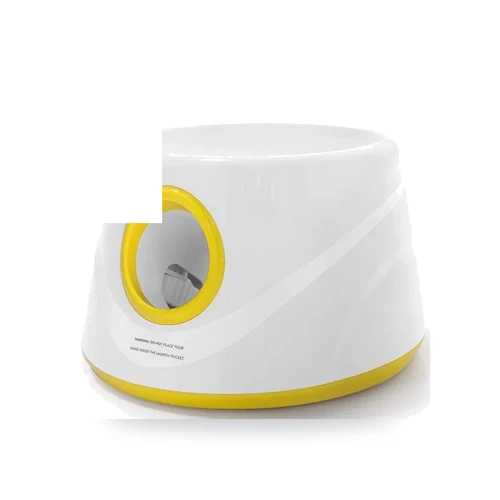
Now combine the two. Sit your dog beside or behind the machine — never in front of the launch pocket; the manual is explicit that hands (and noses) stay out of the pocket while it is on. Drop a ball into the top opening yourself. The loading sensor picks it up and fires about four seconds later; use that pause to point your dog downrange. Ball flies, dog chases, everyone is a hero. Keep sessions to five or ten minutes with breaks — arousal builds fast with machine-fed fetch, and our safety guide explains why over-repetition is the main risk to manage.
Step 5 — Teach the reload (day 5–7)
This is the party trick. Hold a ball over the opening, let your dog watch you drop it, and reward the launch. Then hand your dog the ball near the machine and reward any head movement towards the opening — first for being close, then for touching the rim, then only for a genuine drop-in. The four-second delay is your friend: it gives the dog time to step back before the launch. Some dogs get this in one session; most take a few days of short practice.
The one-week plan at a glance
| Stage | Goal | Session length | You know it's working when… |
|---|---|---|---|
| Day 1–2 | Machine off, dog relaxed near it | Casual, all day | Dog eats treats at the base without hesitating |
| Day 2–3 | Launch sound = treats | 2–3 min, several times | Ears prick at the launch, no backing away |
| Day 3–4 | ETPU ball = favourite toy | 5 min | Dog brings the ball back and wants more |
| Day 4–5 | Chasing machine launches | 5–10 min | Dog waits beside the machine, not in front |
| Day 5–7 | Self-loading | 5–10 min | Ball goes in the opening without your help |
Training a puppy? Go gently
Puppies can absolutely learn the machine — often faster than adults — but their exercise must stay age-appropriate while joints develop.
of formal exercise per month of age, up to twice a day — the puppy rule of thumb
— The Royal Kennel Club, 2026
A four-month-old pup gets about twenty minutes of formal exercise at a time, and a few machine launches on the 6 m setting count towards it. Our dedicated guide to ball launchers for puppies maps the machine's settings to each age stage. For grown dogs, The Royal Kennel Club's baseline is at least one walk a day, often two — the launcher supplements walks, it never replaces them.
Troubleshooting the common snags
Dog is scared of the launch. Go back a step. More distance, better treats, shorter sessions. Fear fades with repetition at a distance the dog chooses.
Dog chases but won't give the ball back. Play the two-ball game: show a second ball the moment they return, and swap. Retrieving is a trade, not a theft.
Dog drops the ball everywhere except the opening. Reward closer and closer approximations. Standing over the machine and treating only opening-drops usually cracks it in two sessions.
Dog loses interest mid-session. Fine — stop. The machine goes into standby after 30 minutes of inactivity anyway. Short and keen beats long and bored.
Which machine is this guide for?
The steps work for any automatic launcher, but the details — 6 m default setting, four-second launch delay, loading sensor, 58 mm balls — describe the FetchMate we sell for small and medium dogs. If yours is a toy breed, start with our small dog launcher guide; if you are still comparing machines, our UK launcher round-up and our Nerf vs automatic comparison will help you choose before you train.
FetchMate Automatic Ball Launcher
Yellow launcher + 3 mini ETPU balls (58 mm) + USB charging cable, in one box.