· Updated 5 August 2026 · Loïc Chiappini
Quiet Dog Ball Launcher UK: How Loud Are They Really?

If you live in a Victorian terrace, a flat above a shop, or anywhere with a shared wall, launcher noise matters as much as ball size or throwing distance. And here is the problem with researching it online: almost nobody measures this. Manufacturers of the machines we can find do not publish noise figures, and the sites that quote precise numbers rarely explain what meter they used, at what distance, at which setting. Without those three things, a number means nothing — so this page contains none. What we can do is more useful anyway: explain what makes an automatic dog ball launcher loud, so you can judge any machine from its design, and set out what genuinely reduces the noise once you own one.
Why launcher noise is a real issue in Britain
Most UK homes are attached in some form — terraces, semis and flats mean party walls, shared ceilings and neighbours within a few metres. A machine that fires every few seconds through a working morning is exactly the kind of repetitive sound that gets noticed through a wall. Outdoors changes everything: even a few metres of garden between the launcher and the boundary makes a real difference, because sound falls away quickly with distance in open air.
It is also a legal question, at the extreme end. Under the Environmental Protection Act 1990, persistent noise that unreasonably affects a neighbour can be treated as a statutory nuisance and investigated by the council's environmental health team. A daily indoor fetch session in a flat, firing every few seconds for a quarter of an hour, is the sort of pattern that could reasonably draw a complaint. Better to design the problem out from the start.
What actually makes a launcher loud
Five sources, and once you know them you can judge a machine you have never heard.
1. The launch mechanism
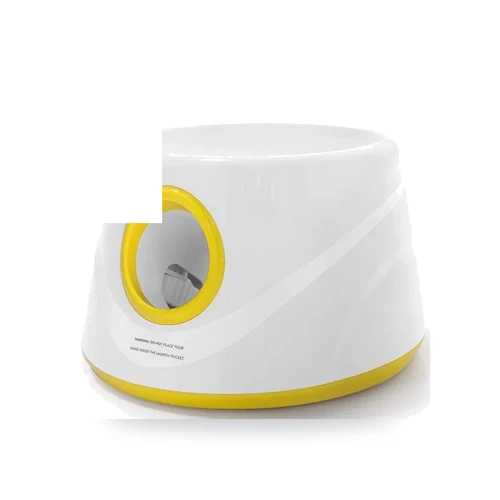
The spring or motor has to accelerate the ball, and it is the signature sound of every automatic launcher — a distinct mechanical note on each throw. On the FetchMate you will hear the launch spring clearly in the same room. It is not silent, and any listing implying a silent launcher deserves suspicion.
2. Ball mass and size
A heavier ball takes more energy to throw and rattles harder on its way out. The FetchMate's 58 mm ETPU foam balls are small and light compared with a standard felted tennis ball, which pushes in the quiet direction — a consequence of the design rather than a marketing claim. Machines built to hurl full-size tennis balls a garden's length are doing more work, and more work is more noise. (Ball formats are compared properly in our ball size guide.)
3. Throwing distance
The same machine is quieter on its shortest setting than its longest, because it fires less hard. The FetchMate offers 6, 10 and 14 metres and always starts on 6 — which is also the only setting the manufacturer recommends indoors.
4. The landing
The ball hitting a hard floor, and the secondary bounce, are often louder than the launch. On grass, this vanishes.
5. Everything that is not the machine
Easy to forget and often loudest in a flat: the dog's paws on floorboards, the claw-scrabble of a fast turn, and the owner cheering. In an upstairs flat, the paws transmit through the floor structure far better than any airborne motor noise.
Our launcher, honestly
We do not publish a noise figure for the FetchMate, because we have not measured it under controlled conditions and the manufacturer does not publish one either. A number invented for a product page would be worth nothing to you. What we can tell you is structural — small foam balls, modest throw distances, compact housing — and behavioural: buyers on the manufacturer's listing describe it as better suited to playing outside than to a small room, which matches the maker's own recommendation. Indoors on the short setting it is clearly audible; through a garden and a back door it fades into ordinary household background. It costs £69.99 with free UK delivery in 3–8 working days, and if quietness is your deciding factor, read this whole page before buying anything — ours included.
Six ways to make any launcher quieter
- Put something soft underneath it. A rubber mat or carpet offcut absorbs vibration into the floor. In a flat this is the highest-impact single change, because structure-borne vibration travels through a building far better than airborne sound.
- Use the shortest distance setting. Less spin-up, softer throw, and indoors you rarely need more anyway.
- Move it outdoors. Even a small garden removes the paws-on-floorboards problem entirely and puts distance between the machine and anyone's wall.
- Mind the hours. Mid-morning and early evening sessions sit inside normal household noise. The same sound at 7 a.m. against a quiet background is far more irritating.
- Soften the landing zone. A rug where the ball lands and the dog turns kills the bounce and the scrabble — and it is kinder to joints than a slick floor, as the safety guide explains.
- Talk to your neighbour first. A thirty-second explanation prevents most complaints. People tolerate a known noise far better than a mystery one.
What suits your housing
| Your home | Sensible approach |
|---|---|
| Detached with garden | Any launcher, outdoors. Choose on ball size and budget, not noise |
| Semi-detached with garden | Outdoor sessions; favour a compact small-ball machine for occasional indoor use |
| Terraced with garden | Outdoors by default; indoors on the shortest setting, on a mat, at sociable hours |
| Flat with a neighbour below | Outdoors if you have grass. Indoors, expect the paws to be the problem, not the motor — see the indoor guide |
| Studio or bedsit | Skip the automatic launcher; a flirt pole indoors or a chucker at the park |
| Any home, sound-sensitive dog | Manual play first, machine introduced gradually |
What your dog hears
Dogs hear well above the human range, and some motors produce high-frequency noise you cannot perceive at all. If your dog ducks, flattens their ears or backs away from a machine that does not sound loud to you, believe the body language rather than your own ears. Rescue dogs, whippets and sighthounds, working-line collies and older dogs are the most commonly sound-sensitive groups — the rescue introduction protocol works just as well for any nervous dog, and buyers on the manufacturer's listing note that the FetchMate can startle a young or timid dog at first, so a gradual start is not optional courtesy.
FAQ
What is the quietest dog ball launcher in the UK?
There is no verified ranking, because nobody publishes comparable measurements. What is predictable from the design is that small-ball, short-throw machines are quieter than full-size, long-throw ones — the category the FetchMate sits in. We still do not put a number on it, and neither should anyone else without a meter and a method.
Will a ball launcher disturb neighbours in a flat?
Quite possibly — usually because of the dog rather than the machine. Paws landing repeatedly on floorboards transmit straight through a floor. Use a mat, the shortest setting, sociable hours, and play outside whenever you can.
Are silent dog ball launchers a real product?
No. Any mechanism that accelerates a ball makes noise, and any dog running about makes more. The genuinely silent option is a manual chucker — compared against machines in our automatic vs manual guide — which trades autonomy for quiet.
Is a quieter launcher better for an anxious dog?
It helps, but predictability matters more than volume. The FetchMate only fires when a ball is dropped into the opening, about four seconds later — nothing happens spontaneously, and that regularity is what a nervous dog learns to trust. Introduce it slowly regardless.
Choosing between models beyond noise? The UK buyer's comparison covers the field, the small-dog guide covers sizing, and the where-to-buy guide covers who sells what.
We have not carried out calibrated acoustic testing on any launcher, and this article deliberately contains no decibel readings — ours or anyone else's.
FetchMate Automatic Ball Launcher
Yellow launcher + 3 mini ETPU balls (58 mm) + USB charging cable, in one box.