· Loïc Chiappini
Indoor Dog Ball Launcher: What Actually Works in a UK Home
Let us not oversell this. An automatic dog ball launcher is designed for the garden, and the FetchMate's manual says exactly that: outdoors is the recommended setting. But British weather has opinions, and so does British housing — plenty of dog owners have no garden at all. So the honest question is not "is indoor use ideal?" (no) but "can it be done sensibly?" (yes, within limits). Here is how.
Why indoor fetch is a real question in the UK
Indoor play is not laziness — for many households it is geometry. A meaningful share of British homes simply have nowhere outdoors to throw a ball.
British households (12%) have no access to a private or shared garden
— Office for National Statistics, 2020
median garden size in London — the smallest of any region in Great Britain
— Office for National Statistics, 2020
Add classic British rain and dark 4pm winters, and a machine that can shorten its throw to living-room scale becomes genuinely useful — as long as you respect what it was built for.
What the manual actually allows
The FetchMate has three launch distances: 6, 10 and 14 metres. Indoors, only Distance 1 — the 6-metre setting — is appropriate, and helpfully it is the default every time the machine switches on, so a mid-session setting mix-up cannot surprise you. The 10 m and 14 m settings are garden settings, full stop. A ball fired 14 metres inside a terraced house is not a game; it is redecorating.
We will also pass on what buyers say, because it matches the manual's caution: buyers on the manufacturer's listing report the machine can feel like a lot for a small room and suits outdoor play better — while others use the short mode indoors happily with a small dog. Both are right. The variable is your floor plan.
Room by room: where it works
| Space | Verdict | Notes |
|---|---|---|
| Hallway | Best indoor spot | A straight, narrow run suits the 6 m launch; shut the doors along it |
| Open-plan living/kitchen | Good | Angle the launcher away from worktops; mind food-prep hygiene |
| Living room (standard) | Workable | Only if you have ~6 m of clear diagonal; move the ornaments first |
| Conservatory | Caution | Glass on three sides — we would not |
| Stairs and landings | No | A dog sprinting downstairs after a ball is an injury waiting to happen |
| Small flat, one room | Skip the machine | Use the rainy-day games below instead — honestly better |
Five precautions before the first indoor launch
1. Clear the flight path. Six metres is further than it sounds indoors. Walk it out; anything breakable inside that corridor is now a participant.
2. Deal with slippery floors. Laminate, tiles and polished wood are where fast dogs lose their footing. A runner rug along the chase line protects joints and hips — worth reading alongside our piece on launchers and arthritis, which covers low-impact fetch in detail.
3. Keep everyone clear of the launch pocket. The manual's firmest warning: never put a hand (or let a nose go) into the launch pocket while the machine is on. Position the launcher so the dog approaches from the side, as covered in our training guide.
4. Expect the sound. You will hear the launch spring each time — it is not silent, and in a quiet flat it is more noticeable than in a garden. Our noise guide covers habituation and timing (perhaps not during the baby's nap).
5. Use only the 58 mm ETPU balls. They are what the machine is calibrated for — a standard tennis ball does not fit it properly, as our ball size guide explains. Count the balls back afterwards; sofas eat them.
Moving it around: built for exactly this
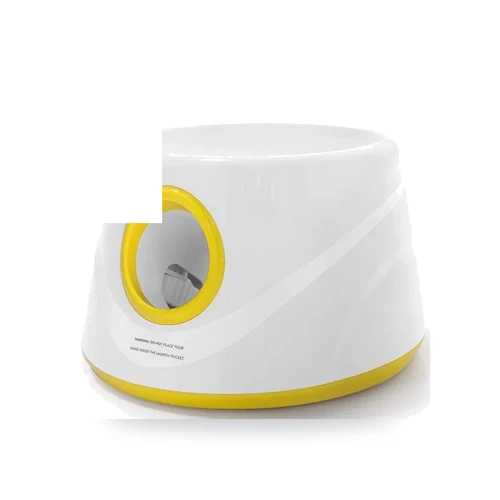
One detail that makes indoor-outdoor life easier: the FetchMate is genuinely small. The unit measures 27 cm across and 18.5 cm high, with a carry handle built into the body, so shuttling it between the garden shed and the hallway is a one-hand job rather than a furniture-moving exercise. The battery LED tells you at a glance whether an indoor session is on the cards — green means more than 90% charge, yellow sits between 25 and 90%, and red below 25% means plug it in tonight. And because it drops into standby after half an hour of inactivity, forgetting to switch it off after a rainy-day session costs you nothing.
Realistic expectations: it is a supplement, not a walk
Indoor launches burn energy, but they do not replace outdoor exercise — with 11.1 million dogs in the UK (PDSA PAW Report, 2025), the daily walk remains the backbone of canine welfare, whatever machines we own. Think of indoor mode as a pressure valve: a rainy Tuesday, a work call that overran, a dog staring at you at 7pm. It also pairs well with a working-from-home routine — we wrote about that in working from home with a ball launcher.
One practical note for indoor sessions: the machine plays for 5–6 hours per charge but will not run while plugged in, so charge it overnight rather than discovering a flat battery at the exact moment the rain starts. It also drops into standby after 30 minutes of inactivity — a sensible built-in session limit.
Rainy-day alternatives (that beat any machine)
Some days the best indoor dog toy is no machine at all. Scatter-feeding and snuffle mats turn a meal into twenty minutes of sniffing; a stuffed food puzzle outlasts most fetch sessions; five minutes of trick training tires a brain faster than fifty throws tire legs; and a game of hide-and-seek — you hide, dog seeks — is free. We would rather you skip a launch session than force one into a space that does not fit it. The machine will still be there when the sun comes out.
The bottom line
Indoor use is possible, sanctioned on the shortest setting, and genuinely handy in a UK winter — but it is plan B by design. If your home has a 6-metre run and forgiving floors, the FetchMate earns its keep year-round, especially for the small and medium dogs it is built for. If you are still weighing up which machine suits your space, our UK ball launcher comparison covers the indoor question for every major model, and our safety guide is worth ten minutes before any first launch, indoors or out.
FetchMate Automatic Ball Launcher
Yellow launcher + 3 mini ETPU balls (58 mm) + USB charging cable, in one box.