· Updated 5 August 2026 · Loïc Chiappini
Puppy Ball Launcher UK: When Is It Safe to Start?
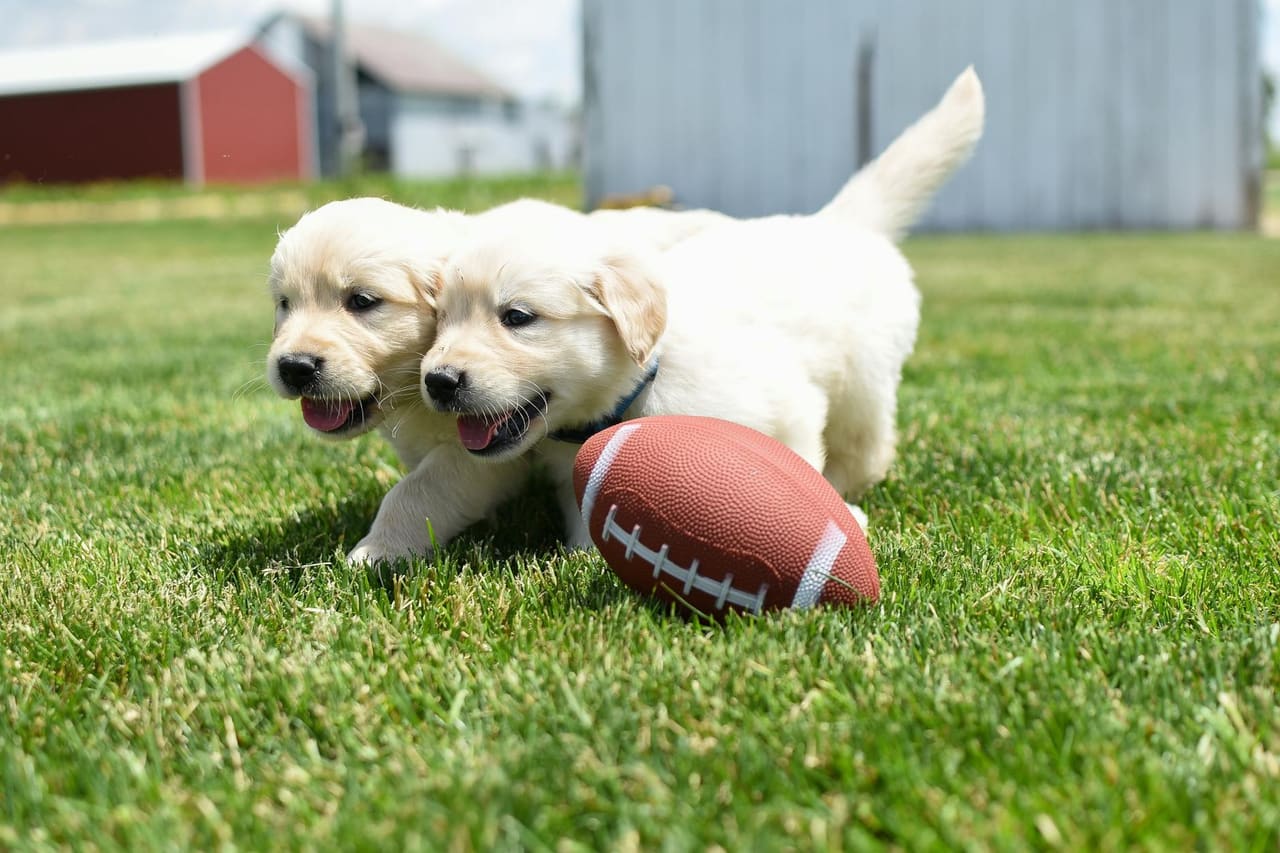
The question usually arrives around the four-month mark, when the puppy is bouncing off the walls and a machine that tires them out sounds like salvation. We sell an automatic dog ball launcher, so believe us when we say the honest answer is the unprofitable one: wait longer than you think. Here is why, and what to do in the meantime.
The growth plate problem
Growth plates are bands of soft cartilage near the ends of a puppy's long bones — the zones where bone lengthening happens. Until they convert to solid bone, they are structurally weaker than the bone around them and vulnerable to compression from repeated impact, shearing from sprint-stop-twist motion, and micro-damage that can heal imperfectly and leave a joint misshapen for life. The joints most exposed are the shoulder, elbow, hip and stifle — precisely the ones fetch loads hardest.
A normal puppy walk is a varied mix of trotting, sniffing and stopping. A fetch session is repetitive maximum-effort sprinting with hard stops and sharp turns, over and over. And a launcher changes the maths in one specific way: a person throwing by hand gets bored after a few dozen throws, while a machine does not. That is the entire appeal of an automatic launcher — and exactly why it is the wrong tool for a growing puppy. The risk is not one throw. It is five hundred.
The conditions most often linked to excessive high-impact exercise in young dogs — hip and elbow dysplasia, cartilage defects, early arthritis — are multifactorial: genetics, growth rate, nutrition and weight all contribute. Exercise is one contributor among several, but it is the one you control, and where surgery is needed the bills run into thousands of pounds. Prevention is very much the cheap option.
Age guidance by breed size
Growth plates close later in larger breeds, which is why a chihuahua and a great dane cannot follow the same timetable. This table is general guidance, not a diagnosis — your vet can assess your specific puppy, and working lines often mature later than show lines.
| Breed size | Examples | Earliest sensible start |
|---|---|---|
| Toy and small | Chihuahua, Yorkie, jack russell, cavalier | 8 months |
| Medium-small | Border terrier, Boston terrier, cocker | 10 months |
| Medium | Working cocker, beagle, corgi | 12 months |
| Medium-large | Border collie, springer, vizsla | 12–14 months |
| Large | Labrador, golden retriever, GSD | 14 months |
| Giant | Rottweiler, mastiff, great dane | 18+ months |
| Brachycephalic | French bulldog, pug, English bulldog | Ask your vet first, at any age |
| Long-backed | Dachshund, basset, corgi | Ask your vet first — spinal risk too |
Flat-faced breeds get their own line because restricted airways plus sustained sprinting plus a warm afternoon is a genuine heat-stress risk, whatever the calendar says. That is a vet conversation, not an age threshold.
What about ordinary fetch before then?
Short, occasional and on grass — reasonable. Three to five minutes at most, a couple of times a week, short rolls rather than full sprints, a soft toy for very young puppies, never on slippery floors or stairs, and stop at the first sign of tiredness. This is play, not exercise. The goal is engagement, not exhaustion.
Better alternatives under the threshold
Puppies need stimulation more than exertion, and mental work tires them remarkably well:
- Scent games — scatter feeding in the grass, snuffle mats, find-the-toy, kibble hidden in cardboard boxes
- Food puzzles — a stuffed and frozen Kong, slow feeders, lick mats
- Short training games — two or three minutes of sit, down and recall, several times a day
- Low-impact movement — well-matched puppy play, on-lead walks of sensible length (the widely used rule of thumb is five minutes per month of age, twice a day), and swimming once your vet is happy
- A flirt pole or gentle tug — you control the speed and can stop instantly, which a launcher cannot offer
UK welfare organisations — the Kennel Club, PDSA, Blue Cross, RSPCA, Dogs Trust — all publish free puppy exercise guidance, and it points the same way: little and often, low impact, brain before brawn. None of them recommends repetitive high-impact fetch for a growing puppy.
The four-week introduction, once your puppy is old enough
Week 1 — familiarisation. Launcher in the room, switched off, treats scattered near it. No firing. One useful thing to know: buyers on the manufacturer's listing note that the FetchMate can startle a young dog at first, so this quiet week is not optional politeness — it is the step that prevents that.
Week 2 — sound, then a single ball. Switch it on with no ball loaded and reward calm behaviour around the hum. At the end of the week, load one ball on the shortest setting — on the FetchMate it fires about four seconds after the ball drops in — and fire once. Whether the puppy retrieves it does not matter.
Week 3 — short sessions. Three sessions, five minutes maximum, shortest distance (6 metres), soft grass only. Watch for limping, hesitation or heavy panting.
Week 4 — normal use. Cap sessions at ten minutes, three a week. Move up a distance setting only if the dog is fit and keen. From there, adult rules apply — about fifteen minutes a session, and the safety guide explains why more is not better. Teaching the self-loading loop itself is covered in the training article.
Choosing a machine for a young dog
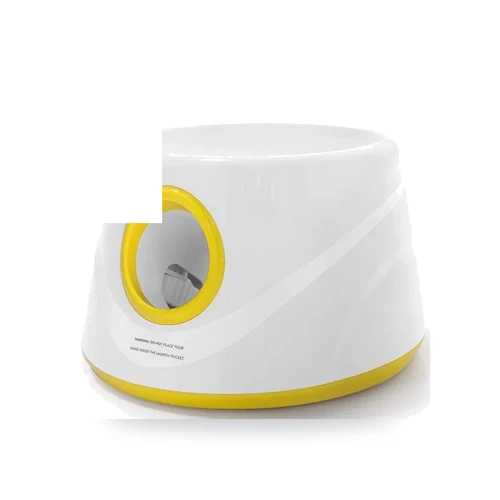
Once your puppy is genuinely old enough, favour a compact machine with adjustable distances so you can start short. The FetchMate throws 6, 10 or 14 metres, always starts on the shortest setting, and uses its own 58 mm ETPU balls — three in the box, and deliberately not standard tennis balls, as the ball size guide explains. It is built for small and medium dogs and costs £69.99 with free UK delivery in 3–8 working days. For a large-breed dog, a 58 mm ball is the wrong size — see the large-dog article, or the full field in our UK buyer's comparison. Small-breed owners will find the sizing detail in the small-dog guide.
Warning signs — stop and call your vet
Even past the safe-age threshold, stop sessions and get your young dog checked if you see any limp, bunny-hopping with the back legs, stiffness after rest, reluctance to jump into the car, yelping during play, panting that does not settle, or a previously keen dog losing interest in fetch — often the first sign of discomfort.
Common scenarios
Labrador puppy, 6 months, enormous energy: do not start. Scent work, stuffed Kongs, lead walks, swimming once your vet approves. Wait until around 14 months.
Working-line collie, 8 months: not yet — working lines mature late. Put the brain to work instead, and wait until at least 14 months.
Cavalier, 9 months: you can begin the four-week introduction, keeping an eye out for the skipping gait associated with kneecap problems in the breed.
Rescue puppy, age unknown: assume the later end of the range, and read the rescue introduction guide — trust comes before exercise.
FAQ
Can a 6-month-old puppy use a ball launcher?
For most breeds, no. Only the smallest breeds are near skeletal maturity at six months, and even then it should be short, supervised sessions on the shortest setting. For medium and large breeds, wait.
Is fetch bad for puppies?
Repetitive high-impact fetch before skeletal maturity carries a real joint risk. Very short, gentle, occasional play on grass is a different thing and generally fine. Launchers are the specific problem because they remove the natural limit on repetitions.
My breeder said fetch from four months is fine — who is right?
On this specific point, ask your vet. The biology is not really disputed: cartilage growth plates are weaker than bone until they ossify, and some traditional advice predates what is now known about it.
General information, not veterinary advice — always consult your veterinary surgeon about exercise for a growing dog.
FetchMate Automatic Ball Launcher
Yellow launcher + 3 mini ETPU balls (58 mm) + USB charging cable, in one box.