· Loïc Chiappini
Nerf Dog Ball Launcher vs Automatic Launcher: Which Should You Buy?
Search for "nerf dog ball launcher" and you will find two completely different machines wearing the same name: a bright plastic hand blaster that fires tennis balls when you pump it, and motorised launchers like our own automatic dog ball launcher that fire balls on their own. They solve different problems. This guide compares them honestly — including the situations where the cheaper Nerf is genuinely the better buy.
What a Nerf Dog blaster actually is
The Nerf Dog range is made under the same brand as the famous foam-dart toys, and the ball blasters work on the same principle: you load a standard tennis ball, pull or pump the handle, and fire. There is no battery, no motor and no charging cable. The clever touch is hands-free pickup — you press the barrel over the returned ball to grab it without bending down or touching a slobbery ball, which anyone who has played fetch in a wet British park will appreciate.
Nerf's retail listings advertise throws of "over 50 ft" — roughly 15 metres — but that figure depends entirely on the model and how hard you work the mechanism. Fire it gently and the ball plops out a few metres away; put your shoulder into it and it sails. That variability is the whole character of the toy: every throw is your throw.
What an automatic launcher does differently
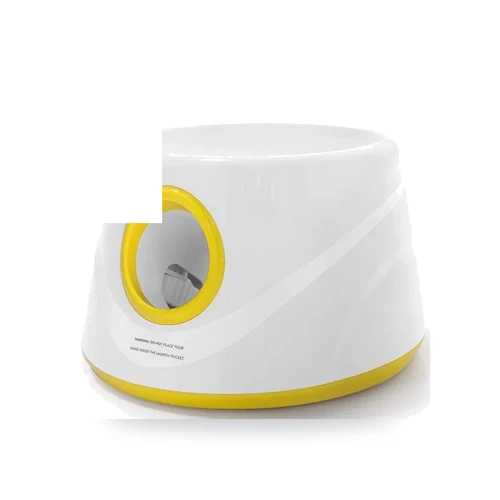
An automatic launcher removes you from the throwing loop. With the FetchMate, your dog (or you) drops a 58 mm ETPU ball into the opening on top, a loading sensor detects it, and the machine fires it about four seconds later. You choose one of three fixed distances — 6, 10 or 14 metres — and the machine repeats that throw identically, launch after launch, for 5–6 hours of play per charge.
That consistency is the point. Once a dog learns to reload the machine itself — our step-by-step training guide shows how — fetch becomes a self-service game. You can supervise from a deckchair, or from your desk if you are one of the many people working from home with a bored dog.
Head to head: the honest comparison
| What matters | Nerf Dog blaster | FetchMate automatic launcher |
|---|---|---|
| How it throws | You pump and fire every shot | Motor fires the ball itself, ~4 s after loading |
| Effort needed | Every throw is your throw | None once the dog learns to reload |
| Distance | Advertised "over 50 ft" (~15 m) — your arm decides | Three fixed settings: 6, 10 or 14 m |
| Ball type | Standard tennis balls | 58 mm ETPU balls — 3 included, not tennis balls |
| Hands-free play | No — you are the machine | Yes, once trained |
| Power | None needed, ever | Rechargeable battery, 5–6 h of play per charge |
| Indoors | Risky at full power | Possible on the 6 m setting only |
| Typical price | Pocket-money territory | £69.99 |
Nerf distance figure is the manufacturer's advertised claim on retail listings, not our measurement. FetchMate specs are from the manufacturer's manual, which we have checked line by line.
Effort: who does the work?
This is the real divide. A Nerf blaster turns fetch into a two-player game — you aim, you fire, you laugh when the ball bounces off the fence. If throwing is part of the fun for you, that is a feature, not a flaw. But if your shoulder aches after twenty throws, or fetch happens three times a day whether you feel like it or not, the appeal fades. We wrote a whole piece on ball launchers for owners with arthritis because "I physically can't throw any more" is one of the most common reasons people go automatic.
Range: advertised vs useful
On paper the Nerf wins on maximum distance. In practice, the question is how much range your garden actually allows. The typical garden in Great Britain measures 188 square metres — generous, but rarely 50 unbroken feet in a straight line. The FetchMate's 14 m top setting fits a typical suburban garden; its 6 m setting even works indoors in a hallway or open-plan room, which no hand blaster can do safely.
median garden size in Great Britain — a 14 m launch fits; a 50 ft blast often doesn't
— Office for National Statistics, 2020
pet dogs in the UK — and every one of them thinks fetch is a full-time job
— PDSA PAW Report, 2025
Price: no contest — the Nerf wins
Let us be straight about this: a Nerf Dog blaster usually costs a fraction of the price of any automatic launcher. Ours is £69.99; premium machines from other brands cost considerably more, as our UK launcher round-up shows. If your budget stops at a tenner or two, the Nerf is not a compromise — it is the right call, and your dog will not know the difference. A thrown ball is a thrown ball.
When the Nerf Dog blaster is the better choice
We sell automatic launchers, so take note when we tell you not to buy one. Choose the Nerf if:
- Budget is tight. It delivers 90% of the joy for a fraction of the cost.
- You want shared play. The blaster keeps you in the game; an automatic launcher deliberately takes you out of it.
- Your dog is large. Nerf blasters fire standard tennis balls, which suit big mouths. Our 58 mm balls do not — we explain why in our guide to ball launchers for large dogs.
- You hate charging things. The Nerf never runs flat. The FetchMate plays for 5–6 hours per charge but will not run while charging.
When an automatic launcher earns its keep
Go automatic if you need fetch to happen without you: during work calls, when mobility is limited, or for a ball-obsessed dog whose appetite outlasts any human arm. It also throws with a consistency that helps nervous rescue dogs learn the game at their own pace, and the short 6 m setting gives small dogs a sensible distance rather than a heroic one. One honest caveat: it makes a mechanical sound when it fires — buyers on the manufacturer's listing note it can startle some puppies at first, something we cover in our safety guide.
The verdict
These two machines are not really rivals; they are different tools. The Nerf Dog blaster is a brilliant, cheap upgrade to your own arm. An automatic launcher replaces your arm entirely. Plenty of households sensibly own both — the blaster for weekend park trips, the automatic for daily garden sessions. For a deeper look at the manual-versus-motor question, see our automatic vs manual launcher comparison, and if you decide to go automatic, here is what we sell and exactly what it does — and does not — do.
FetchMate Automatic Ball Launcher
Yellow launcher + 3 mini ETPU balls (58 mm) + USB charging cable, in one box.