· Updated 5 August 2026 · Loïc Chiappini
Rescue Dog Ball Launcher: A Gentle Week-by-Week Introduction
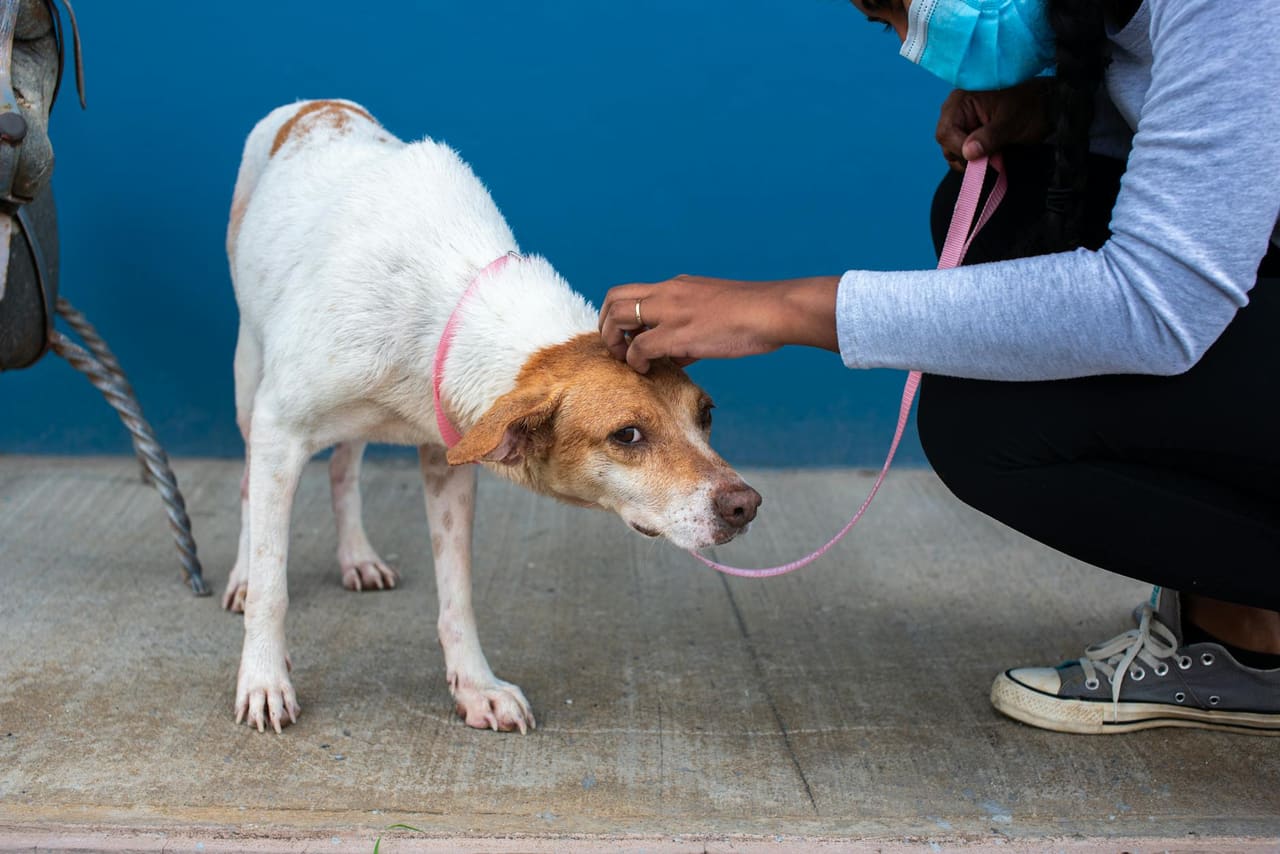
A newly adopted dog and an automatic dog ball launcher are, in the first few weeks, a bad combination. A machine that hums and fires a projectile is close to a worst-case introduction for an animal who has just moved into a stranger's house and does not yet know whether anything here is safe. That does not mean it will never work — plenty of anxious rescues end up loving structured fetch, and a game the dog can start and stop themselves suits some nervous dogs better than being thrown to by a human they are still learning to read. It is a question of sequence and pace, not of whether. This protocol is deliberately conservative: if you are ever unsure about moving to the next stage, don't.
The 3-3-3 rule, and why you cannot shortcut it
Most UK rescues hand adopters the 3-3-3 rule. Three days: the dog is overwhelmed, often shut down, learning the smells of the house — do not read this period as their personality. Three weeks: routines form, character appears, and anxiety triggers become visible for the first time. Three months: the dog trusts the household routine, and only now should genuinely novel experiences be introduced.
A ball launcher is categorically a novel, high-stimulation experience: mechanical noise, movement, and a flying object. Pushing it early can sour the dog on fetch permanently and — worse — attach a "scary moving thing" association to your own garden, the one place they are supposed to feel safe. Wait the three months. There is no exception for "but they seem fine already".
Learn the stress signals before you start
Dogs do not go from calm to snapping in one step; there is a well-documented escalation, and the bottom rungs are the ones people miss. Keep notes during every session — a pattern of "uncomfortable at three metres, fine at five" tells you exactly where to start next time.
| Stage | What you see | What to do |
|---|---|---|
| Subtle appeasement | Yawning when not tired, lip licking, head turned away, whites of the eyes showing | Slow down; add distance from the machine |
| Increased appeasement | Suddenly sitting or lying down, lifting a paw, freezing or moving slowly | Stop the session — not after one more rep |
| Active avoidance | Walking away, hiding, refusing even high-value food | Stop and drop back two stages |
| Defensive signals | Low growl, lifted lip, raised hackles | End completely; reassess with a professional |
You do not push a rescue dog through discomfort. The trust you spent three months building takes far longer to rebuild than it took to earn.
Why predictability matters more than volume
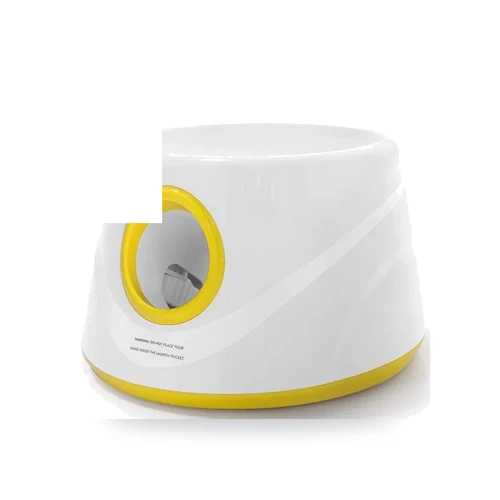
The useful thing about the FetchMate for a nervous dog is not any special quiet mode — it has none, and you will hear the launch spring on every throw. It is that nothing happens spontaneously. The machine fires only when a ball is dropped into the opening on top, roughly four seconds later, every time. No ball in, no launch. That regularity is learnable: the dog discovers that they control when the ball flies, and control is the antidote to anxiety.
Two honest caveats. First, buyers on the manufacturer's listing note the machine can be intimidating for a timid or young dog at first — which is exactly why the weeks below exist. Second, the manufacturer's manual warns against putting a hand into the launch pocket while the machine is on; the same goes for noses, so the step-back habit in week eight is a safety behaviour, not a nicety. For what makes any launcher loud and how to soften it, see the noise guide; for the wider risk picture, the safety guide.
The week-by-week introduction
This assumes the dog has been home at least ten weeks and shows no resource guarding around toys and no established noise phobia. Repeating a week is never a failure.
Week 1 — the launcher is furniture. Switched off, no balls, in the corner of the room your dog likes best. It simply exists. If the dog starts avoiding that side of the room, you have gone too fast — move it away and try again later.
Week 2 — the launcher dispenses food. Something high-value on top of the machine, several times a day. After three days, beside the loading opening; after five, inside it. Goal: the launcher predicts food.
Week 3 — switch it on, no ball. The dog hears the standby hum while you sit a few metres away rewarding calm. They do not have to approach.
Week 4 — first firing, dog elsewhere. Settle the dog in another room with a chew. In the garden, fire one ball on the 6-metre setting, wait, fire a second. Calm curiosity at the door afterwards is a pass; barking or hiding means go back to week 3.
Week 5 — firing at a distance. Dog on a lead, five or six metres back, treats flowing. Fire one ball; reward calm. Three to five repetitions, ten minutes maximum. You collect the balls — the dog is not chasing yet.
Week 6 — teach the chase, manually. Put the machine away and throw a ball a short distance by hand. Plenty of rescues have never played fetch — chasing a ball is a learned game, not an instinct that switches on automatically. If the dog has no interest, spend two or three weeks on manual play before returning to the machine; our training guide covers building the retrieve from scratch.
Week 7 — launcher fires, you load. Shortest setting. You drop the ball in and step back with the dog; encourage the chase; you reload. The dog never approaches the opening this week.
Week 8 — the dog loads it themselves. As the dog returns with a ball, guide them to drop it into the opening — then immediately encourage a step back. The four-second delay before the launch is your training window: ball in, back up, ball flies, chase. Within five to ten repetitions most dogs get the loop, and from there the dog runs the session.
Weeks 9 to 12 — build duration. Add a minute at a time up to about fifteen minutes, still watching for the low rungs of the ladder. If tension creeps back, shorten sessions rather than pushing through.
When it goes wrong
Setbacks are normal. The rule: drop back two stages, not one, and spend a week there. Common causes are a jam or odd noise mid-session, a household change, too long a session the day before, or a second dog turning the game competitive. If the dog refuses to enter the room where the launcher lives, go all the way back to week 1 — it costs a fortnight; pushing on costs the game entirely.
Which rescues this suits — and which it does not
It generally works for under-socialised shelter dogs, overseas rescues with limited early exposure, older dogs introduced gently, dogs with mild noise sensitivity, and ex-working breeds with a retrieve instinct. It is generally not appropriate for dogs with a diagnosed behavioural disorder or severe sound phobia, resource guarders (the ball becomes a guarded object), compulsive high-drive dogs, flat-faced breeds with breathing limits, or arthritic seniors — the arthritis article covers gentler options, and young rescues of unknown age should be treated by the cautious timelines in the puppy guide. If you are unsure which group your dog is in, one session with a qualified behaviourist (APBC or similar registration) is worth more than guessing.
FAQ
How long after adopting should I wait?
At least ten weeks, following the 3-3-3 rule. Some dogs need six months or more. There is no advantage in rushing it.
My rescue will not fetch at all — is something wrong?
No. Fetch is learned, and many rescues were never taught it. Some dogs simply never take to it, which is a preference, not a problem — scent work suits many of them better.
Is an automatic launcher safe for an anxious dog?
Introduced slowly, it can be — the FetchMate fires only when a ball is loaded, which makes it predictable rather than random. What it will not do is treat the underlying anxiety; that is work for a qualified behaviourist, sometimes with veterinary input.
Does it help with separation anxiety?
Only indirectly — a well-exercised dog settles more easily. It is not a substitute for gradual absence training, on which Battersea, Dogs Trust and the Blue Cross all publish free guidance.
The FetchMate is £69.99 with free UK delivery in 3–8 working days and a 30-day return window — sized for small and medium dogs, with the details in the small-dog guide and alternatives compared in the UK buyer's comparison.
General information, not behavioural or veterinary advice. For a dog with a diagnosed behavioural condition, work with your vet or a qualified behaviourist first.
FetchMate Automatic Ball Launcher
Yellow launcher + 3 mini ETPU balls (58 mm) + USB charging cable, in one box.