Ball Launcher for Small Dogs: Get the Ball Size Right First
Most machines on the UK market are designed around a full-size tennis ball and a big back garden. That suits a labrador. It does not suit a jack russell, a cavalier or a cocker — and those are exactly the dogs millions of UK homes actually have. This guide covers what genuinely matters when you are choosing a ball thrower for a small dog: ball diameter first, throw distance second, and what the machine can honestly do indoors on a wet Tuesday in February. Every FetchMate spec below comes from the manufacturer's manual, not from a marketing page — that is how we work.
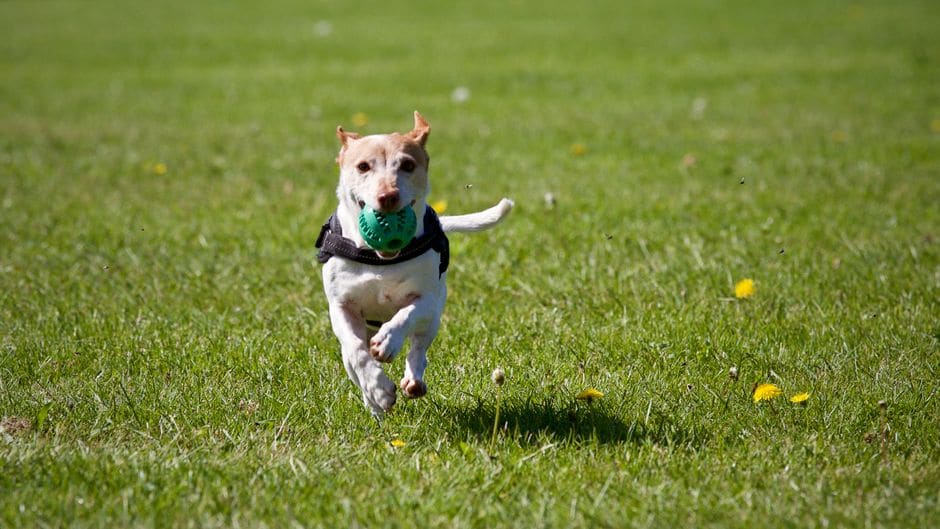
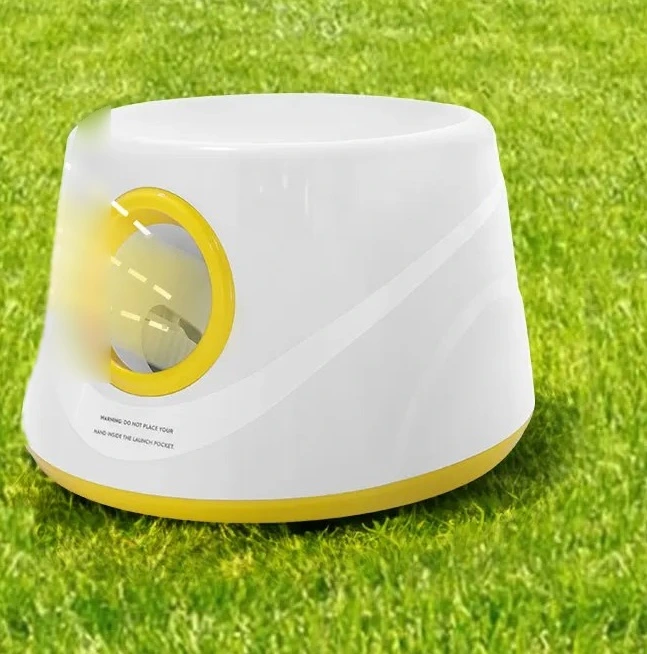
Why ball size matters more than any other spec
A standard tennis ball measures 6.5–6.8 cm across. For a lot of small jaws that is simply too much ball. The dog paws at it instead of picking it up, drops it halfway back, or gives up on the game entirely — and an automatic launcher a dog cannot reload is an expensive doorstop. Whatever a listing promises, check the ball diameter before anything else. Our ball size guide goes deeper on matching ball to jaw.
FetchMate launches 58 mm (2.3-inch) balls — noticeably smaller than a tennis ball, and a size most dogs between roughly 5 and 25 kg can grip properly behind the canines, carry back and drop into the opening on top. Three balls come in the box. They are made of ETPU foam: light on teeth, chew-resistant, though the manufacturer is honest enough to describe them as "not completely unbreakable" — check them now and again and retire any ball that starts to break up.
One thing worth knowing before you buy any 58 mm machine, ours included: standard tennis balls are not compatible. The launcher was built around the 58 mm ETPU format and the manufacturer recommends using only those balls, so spares mean buying the right size rather than raiding the tennis bag.
Ball sizing also cuts the other way, and this is a safety point rather than a sales one. A ball small enough to slip behind the tongue of a big dog is a choking hazard. That is why we do not recommend FetchMate for dogs over about 25 kg — a labrador or a shepherd needs a standard-ball machine, and our large dog launcher guide covers those options honestly. The wider risks of automatic fetch are in our safety guide.
Which dogs the 58 mm format suits
The comfortable band for a 58 mm ball runs from a jack russell to a working cocker: cavalier King Charles spaniels, border terriers, beagles, miniature schnauzers, cockapoos, whippets, corgis, pugs, and most rescue crossbreeds in the 8–22 kg range. Border collies at the lower end of their weight range fit too — just watch the obsession risk that comes with any collie and a ball machine.
These are not low-energy dogs. The Kennel Club's breed pages put both the cocker spaniel and the jack russell terrier at up to an hour of exercise every day — a machine that throws 6 to 14 metres, over and over, makes a real dent in that without wrecking your shoulder.
Pet dogs in the UK — a record high, and most of them are not large breeds
Exercise The Kennel Club recommends for a cocker spaniel — fetch is one of the efficient ways to fill it
The same daily figure The Kennel Club gives the jack russell terrier, despite its size
— The Royal Kennel Club, Jack Russell Terrier breed profile, 2026
Two honest exclusions. Genuinely tiny toy breeds — a chihuahua or a yorkie under about 5 kg — may still find 58 mm a mouthful, and a mini-ball machine built around a smaller format can suit them better; our UK launcher comparison names the alternatives rather than pretending they do not exist. And dogs over 25 kg should skip this page entirely, as covered above.
Indoor fetch: what Distance 1 is actually for
Small dogs are disproportionately indoor dogs — flats, terraces, retired knees, Great British weather. So the shortest setting matters more than the longest one. FetchMate's Distance 1 throws 6 metres, which works down a hallway or across a long living room, and the machine always powers on at Distance 1 — it will never surprise you with a 14-metre throw indoors because someone left it on the park setting.
Two honest caveats. First, the manufacturer recommends outdoor use as first choice; indoors is fine on Distance 1, but clear the runway. Second, you will hear the launch spring on every throw — it is not silent. Buyers on the manufacturer's listing report using the short mode indoors happily with a small dog, and also that a nervous puppy can find the first launches startling, so build the machine up slowly with treats before the first throw. Our puppy guide and training walkthrough cover the habituation steps, and the indoor fetch guide covers room setup.
The loading loop is simple enough for the dog to run alone: drop one ball into the opening on top, the loading sensor picks it up, and the ball fires about four seconds later. Most dogs in this size band learn to reload it themselves — which is the whole point of our automatic dog ball launcher, and the reason it earns its place through a British winter. If nobody plays for 30 minutes it puts itself into standby.
FetchMate specifications — the full sheet
| Spec | What the manual says |
|---|---|
| Throw distances | 3 settings: 6 m / 10 m / 14 m (19 / 32 / 45 ft) — Distance 1 is the default at power-on |
| Balls | 3 × ETPU balls, Ø 58 mm (2.3") included — not tennis balls; use 58 mm ETPU only |
| Launch cadence | Drop one ball in the top opening → launched in about 4 seconds (loading sensor) |
| Battery | Built-in rechargeable; about 6 h to charge, 5–6 h of play per charge |
| While charging | Does not launch during charging — plan play around it |
| Charging kit | USB cable included; 5V 2A–3A mains adaptor not included |
| Battery LED | Red below 25% · amber 25–90% · green above 90% |
| Auto standby | After 30 minutes of inactivity |
| Size | 27 cm wide × 18.5 cm high (10.6" × 7.2"), with a carry handle |
| In the box | Launcher ×1 · ETPU balls ×5 · USB cable ×1 · manual ×1 |
| Price & delivery | £69.99 — free UK delivery in 3–8 working days, 30-day returns |
What the listings don't tell you. Four facts straight from the manual that most product pages skip: the launcher does not fire while it is charging, so top it up between sessions rather than during them; it drops into standby after 30 minutes idle; the mains adaptor is not in the box, so you will need any 5V 2A–3A USB plug you already own; and spare balls must be 58 mm ETPU — a standard tennis ball will not feed. Safety note from the same manual: never put a hand in the launch pocket while the machine is on.
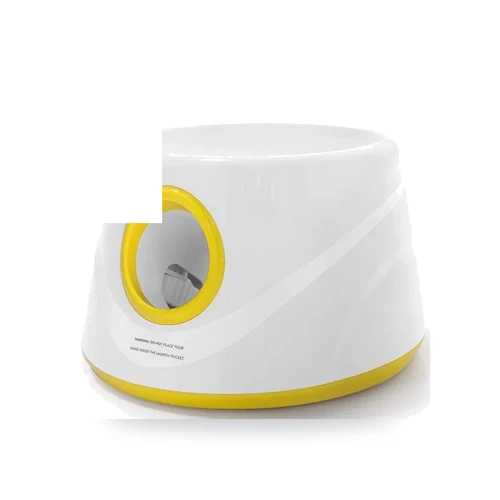
FetchMate Automatic Ball Launcher
Yellow launcher + 3 mini ETPU balls (58 mm) + USB charging cable, in one box.
Small dog ball launcher FAQs
What size ball does a small dog ball launcher need?
Smaller than a standard tennis ball. Tennis balls measure 6.5–6.8 cm across, which is too much ball for many small jaws. FetchMate launches 58 mm ETPU balls — a size that suits most dogs between roughly 5 and 25 kg. For genuinely tiny toy breeds, an even smaller mini-ball machine can be a better fit.
Can I use an automatic ball launcher indoors?
Yes — on the shortest setting. FetchMate powers on at Distance 1 (6 m), which works in a hallway or a long living room, and the manufacturer recommends outdoor use as first choice. Expect to hear the launch spring on every throw: it is not silent, so introduce sound-sensitive dogs gradually.
Is an automatic ball launcher suitable for a puppy?
With patience, usually. Buyers on the manufacturer’s listing report that some puppies find the launch startling at first, so start with the machine switched off, reward calm behaviour around it, and keep early sessions short on Distance 1. If you are unsure whether fetch suits your puppy’s age and joints, ask your vet first.
What if my dog weighs more than 25 kg?
Choose a launcher built around standard tennis balls instead. A 58 mm ball is small enough to be a choking hazard for a large dog, which is why we do not recommend FetchMate above roughly 25 kg. The PetSafe Automatic Ball Launcher is the established standard-ball option for big breeds.