· Updated 5 August 2026 · Loïc Chiappini
Working from Home with a Dog: Ball Launcher Routines
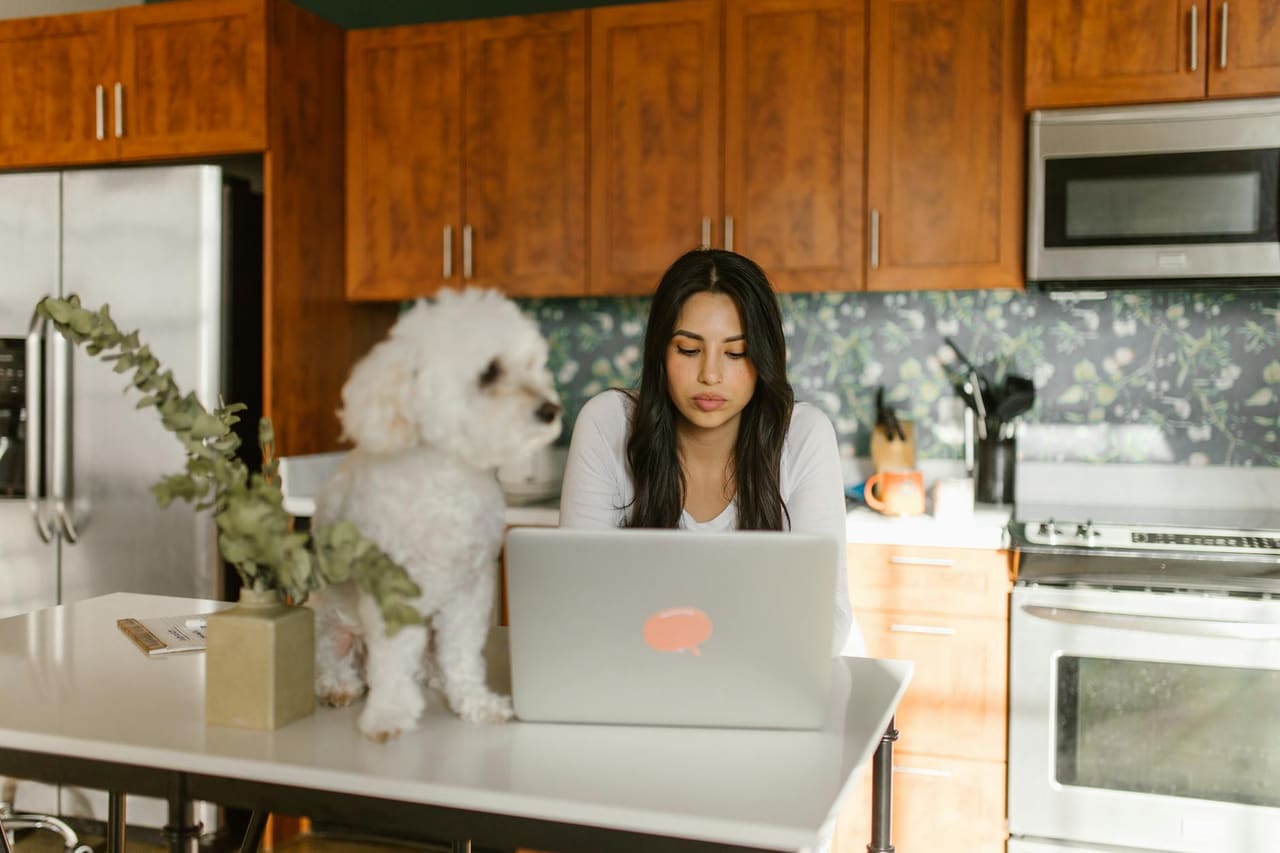
There is a particular kind of working-from-home guilt that arrives around eleven o'clock. You are on a call with three people. The dog is licking the window, sighing theatrically, then bringing you a toy you cannot take. An automatic dog ball launcher is one of the few pieces of kit that genuinely helps, because it moves part of the physical exercise load off your calendar. It is also routinely oversold. Here is what it does, what it does not, and how to set one up in a British house without falling out with the neighbours.
Why the WFH exercise maths does not work
A working-bred dog was built to be busy for hours; a home worker has half an hour at lunch and an hour in the evening. Two things make it worse in a home-working household specifically. First, the dog is never alone, so they never learn to switch off — presence is stimulating, and every time you stand up, they stand up. Second, the interruptions are unstructured: a nudge during a call earns a stroke, so nudging during calls gets reinforced. The result is a dog that is under-exercised and over-attended. For what your breed actually needs, the Kennel Club breed pages and the veterinary charities — PDSA, Blue Cross, Dogs Trust — publish free, well-sourced guidance.
What a launcher actually changes
Exercise density
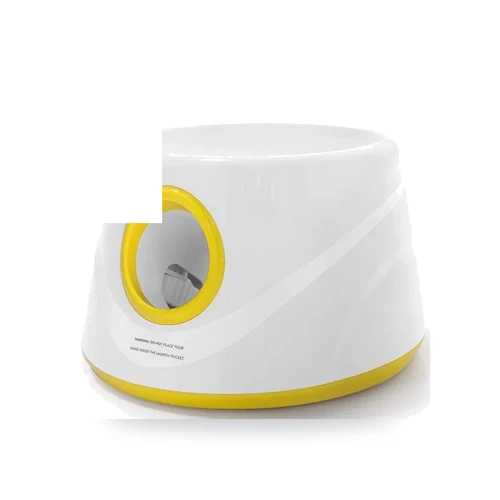
A human shoulder manages a few dozen throws. A machine fires as long as balls keep going in — on the FetchMate, each ball dropped into the top opening launches about four seconds later, at 6, 10 or 14 metres. Sprint, stop, turn, return, repeat: per minute, that asks far more of the dog than a lead walk ever does. We will not put a walk-conversion figure on it, because it depends entirely on the dog, the surface and the setting — every number you see quoted for this online is made up.
The dog runs themselves down to a settle
A good session has a visible endpoint: the dog brings the ball back and, instead of loading it, lies down beside the machine. That is the dog saying they are done. Most owners find the dog sleeps solidly afterwards — and that block of sleep is the real benefit to your working day, more than the exercise itself.
You barely leave your desk
Load the balls, open the back door, go back to your call. Two minutes at either end instead of forty in the middle. The machine handles the physical load; you still owe the dog mental stimulation and social contact, and no launcher covers either.
Setting it up in a British house
Setup A — back garden (by far the best)
Launcher on the patio, firing down the lawn, you inside on your call. This removes the two biggest indoor problems at once: noise through the floor, and a dog cornering on a slick surface. Check the run-off — the dog needs space to slow down past where the ball lands, not a shed. The manufacturer recommends outdoor use, and buyers on its listing agree the machine suits a garden better than a small room.
Setup B — living room, with limits
Shortest setting only — 6 metres is the one distance the manufacturer recommends indoors — with the machine on a non-slip mat and a rug in the dog's turning zone, because hard floors are hard on joints. In a flat, remember that downstairs neighbours hear paws, not motors. The indoor guide covers room layouts in detail.
Setup C — hallway (avoid)
A corridor looks ideal and is not: there is no run-off, so the dog decelerates into a door frame at full speed, mid-way through your meeting.
Flats without outdoor space — the honest answer
A launcher is a poor fit. The paw-thump above a downstairs neighbour is antisocial, and indoor run-ups are too short to give a high-drive dog anything meaningful. A flirt pole burns comparable energy in a fraction of the space and is nearly silent. That is not a sale we want to make badly — the noise guide explains the full picture.
A daily rhythm that works
| Time | Activity | Roughly |
|---|---|---|
| Early morning | Proper walk, off lead somewhere safe | 40–45 min |
| Breakfast | Slow feeder or scatter-fed in the garden | 15 min |
| Mid-morning | Launcher session, garden | 10–15 min |
| Late morning | Work block — dog sleeping | 90 min |
| Lunch | Lead walk: sniffing, novelty, other dogs | 30 min |
| Afternoon | Work blocks, with one short launcher session between them | 10 min |
| Evening | Scent work or training games, then the second walk | 50–60 min |
The pattern that matters is arousal followed by settle, several times a day — not one enormous burst. Two launcher sessions a day is the sensible ceiling for an adult dog; more starts to feed obsession rather than tire it, as the safety guide explains. One practical FetchMate note: it does not run while charging, so charge it overnight — a full charge (about six hours from a USB adaptor) gives five to six hours of accumulated play, which at fifteen minutes a day is weeks of sessions. It also puts itself into standby after thirty minutes idle, so a forgotten machine is not firing at pigeons all afternoon.
Which dogs benefit most
Border collies (who need the mental work as much as the running), working cockers and springers, jack russells and similar terriers — a lot of engine in a small frame, well suited to the compact format in our small-dog guide — and other genuinely fetch-driven dogs in the small-to-medium band. It does not suit flat-faced breeds, long-backed breeds, seniors with stiffness (see the arthritis article), puppies whose growth plates are still open (the puppy guide has the timelines), dogs over about 25 kg (the FetchMate's 58 mm balls are the wrong size for them), or dogs with no fetch drive — no machine creates interest that is not there.
Does it really run unattended?
Broadly yes, with three conditions. It takes a week or two of supervision first, while the dog learns the loop — drop the ball in, step back, chase; the training guide shortens this. One dog at a time, because two dogs turn loading into a shoving match. And you need a way to check: stop the session the moment the dog limps, hesitates or skids. Remember the manual's warning — nothing goes into the launch pocket while the machine is on, hands or noses — and put the launcher away between sessions, or it becomes the thing the dog pesters you about all day, which is the exact problem you bought it to solve.
FAQ
Can I leave a ball launcher running while I work?
Once the dog has learnt the loading sequence, yes — with short sessions and a way to see or hear what is happening. Battery life is not the limit: the FetchMate gives five to six hours of play per charge, while a sensible session is ten to fifteen minutes. Joint stress and over-arousal are what set the cap.
Will the noise disturb my calls?
You will hear the launch spring in the same room — it is not silent, and we do not publish a noise figure because we have not measured one. From another room with the back door shut, the dog's feet are more likely to reach your microphone than the machine is.
How much walking does a launcher replace?
Less than the marketing implies, and we will not invent a ratio. It takes the physical edge off faster than a walk does, but it does nothing for sniffing, novelty or meeting other dogs. A supplement, never a substitute.
My dog interrupts every call. Will this fix it?
Partly. A tired dog interrupts less, but interruption is also a learnt habit. Pair the launcher with a settle routine — a bed near your desk, rewarded for lying on it — and give attention when the dog is calm rather than when they ask.
The FetchMate is £69.99 with free UK delivery in 3–8 working days and a 30-day return window; if you are still comparing machines, start with the UK buyer's comparison.
We are a small UK online shop, not trainers or behaviourists — for anything involving your dog's joints, breathing or behaviour, speak to your vet or a qualified professional.
FetchMate Automatic Ball Launcher
Yellow launcher + 3 mini ETPU balls (58 mm) + USB charging cable, in one box.