· Loïc Chiappini
Types of Dog Ball Explained — And Which Fit a Launcher
The seven types, and what each is actually for
1. The tennis ball
The default, and the most misunderstood. A regulation tennis ball is 6.5–6.8 cm across and covered in felt. The felt is the problem: it picks up grit and works like fine sandpaper on enamel over years of daily carrying. Dog enamel is thinner than ours and does not grow back. Tennis balls are fine occasionally; as a dog's only ball for a decade, they are not. Our ball size guide goes into the sizing side properly.
2. The rubber fetch ball
Solid or hollow rubber, no felt, usually bouncier and easier to clean. Better for teeth than felt, heavier in the mouth, and it travels unpredictably on hard ground — which is either the appeal or the problem, depending on your dog and your patio doors.
3. The treat ball
A hollow ball with an opening that dispenses kibble as the dog rolls it. This is not a fetch toy at all — it is enrichment. It slows eating, occupies a dog alone in a room, and works the nose and brain rather than the legs. Very good for the hour after exercise when a dog needs to come down rather than go up. Do not expect it to tire a collie on its own: mental work and physical work are complementary, not interchangeable.
4. The ball-in-ball toy
An outer ball with a second ball rattling inside, usually in tough rubber. The appeal is the noise and the odd bounce; the real benefit is that it is hard to destroy and hard to swallow. A reasonable choice for a solo chewer, useless in a launcher — the shape and weight are wrong.
5. The herding ball
A large, hard ball — often 20 cm or more — that the dog pushes with its nose and chest rather than carrying. Built for herding breeds with no sheep to herd: collies, kelpies, shepherds. It scratches an instinct that fetch does not touch, and it is genuinely useful for dogs who become obsessive about small balls, because there is nothing to fixate on carrying. Outdoor only, and never one small enough to fit in the mouth.
6. The "indestructible" ball
A category built on a word that is not true. Nothing survives a determined power chewer forever, and the toughest balls tend to be the hardest — which is its own risk, because a ball harder than a tooth is how teeth fracture. What you actually want is chew-resistant and slightly yielding: firm enough to survive normal play, soft enough to give under a molar. Treat "indestructible" as marketing and inspect any ball regularly, whatever it cost.
7. The launcher ball
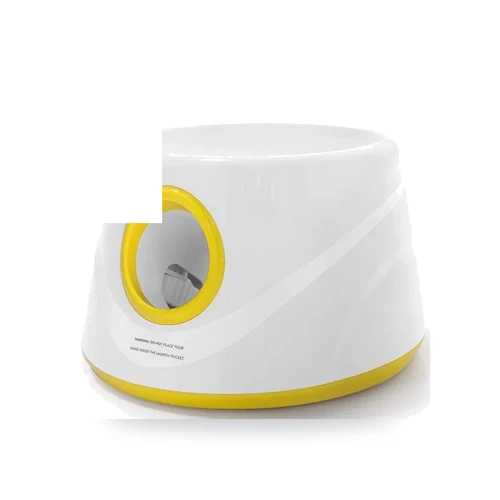
Purpose-built to be fired by a machine, and this is where sizes stop being interchangeable. Every automatic launcher is engineered around one ball diameter, because the feed mechanism grips it. Ours takes 58 mm ETPU foam balls — three come in the box. ETPU is light on teeth, chew-resistant, and the manufacturer is honest enough to call it "not completely unbreakable", which is more than most listings manage.
Which balls fit which machine
| Machine | Ball it takes | Tennis ball compatible? |
|---|---|---|
| FetchMate | 58 mm ETPU foam | No — 6.5 cm will not feed |
| iFetch Original | 1.5 in mini balls | No |
| iFetch Too | 2.5 in balls | Standard-size range |
| PetSafe Automatic Ball Launcher | Standard tennis balls | Yes |
Machine specs checked against manufacturer pages, August 2026. Always confirm the current listing before buying spares — ball formats change between product generations.
The practical rule: buy spare balls for the machine, not for the dog. A cupboard full of tennis balls does not help if your launcher takes 58 mm foam. And a ball that is slightly too small is worse than one slightly too big, because it can double-feed and jam.
Matching ball to dog, not to machine
Size is a safety issue before it is a performance one. A ball that fits behind the tongue of a large dog is a choking hazard — which is exactly why we do not recommend our own 58 mm machine for dogs over roughly 25 kg, and why the large dog guide points those owners at standard-ball machines instead. In the other direction, a tennis ball is simply too much ball for a lot of small jaws: the dog paws at it, drops it halfway back and loses interest. That is the whole argument of our small dog launcher guide.
Between those extremes, pick for the game you actually play. Daily fetch in the garden: launcher balls, several of them, replaced when they start to break up. Solo enrichment while you work: a treat ball, covered in our working from home guide. A collie who cannot switch off: a herding ball and fewer small-ball sessions, for reasons the safety guide explains.
How many balls you actually need
More than you think, for a reason that has nothing to do with wear. A single ball turns fetch into a queue: dog returns, you wait, you load, you throw. Three or four balls in a pocket keep the rhythm going and stop the dog standing over the machine. That rhythm is also what makes machine-fetch trainable in the first place — the loop never breaks, which is how dogs learn to load it themselves. Our training guide uses exactly that.
Then there is the hedge tax. Any garden with a hedge quietly absorbs balls. Budget for losses rather than being surprised by them, and check the survivors every few weeks — retire any ball that has started to split, whatever the packaging promised.
The short version
- Fetch and launcher balls — legs and rhythm. Match the diameter to the machine, exactly.
- Treat and puzzle balls — brain and nose. Best used after exercise, not instead of it.
- Herding balls — instinct, for the breeds that need it. Too big to carry, and that is the point.
- Tennis balls — fine now and then, poor as a decade-long default because of the felt.
- "Indestructible" — a claim, not a category. Inspect everything, regularly.
FetchMate Automatic Ball Launcher
Yellow launcher + 3 mini ETPU balls (58 mm) + USB charging cable, in one box.