· Loïc Chiappini
Are Indestructible Dog Balls Real? An Honest Answer
Why the word keeps selling
Every owner of a heavy chewer has had the same week: a new ball on Monday, a pile of fragments by Friday. So a listing promising "indestructible" reads like relief. The trouble is that it is unfalsifiable in the way that matters — no manufacturer defines which dog, chewing how often, for how long. A ball can be genuinely tough and still fail against a bull terrier with a habit.
Even our own launcher balls carry that honesty in the manufacturer's own words: ETPU foam is chew-resistant, and the maker describes it as "not completely unbreakable". We keep that phrasing on the site deliberately. It is less impressive than the alternative and considerably more true.
The part most listings never mention: harder is not safer
There is a straightforward physical limit here. A ball harder than a tooth does not yield when a molar bites down — the tooth does. Cornell University College of Veterinary Medicine puts it plainly: fractured teeth are commonly caused by chewing very hard objects, and they advise avoiding antlers, hooves and bones, which may break a tooth or splinter.
the test most veterinary dentists use: if you cannot leave a dent in it with your fingernail, it is too hard for your dog
That test takes three seconds and it is the single most useful thing in this article. Press your thumbnail into the ball. If it leaves a mark, the material will give before a tooth does. If it feels like pressing a worktop, put it back — whatever the packaging claims about durability, and however much it cost.
Cornell also flags ice cubes, which surprises people. Same principle: frozen water is harder than enamel.
What actually makes a ball last
Durability is not one property. Three different things get bundled under the word "tough", and they fail differently:
| Property | What it resists | What it costs you |
|---|---|---|
| Hardness | Puncture from a single hard bite | Tooth fracture risk if it exceeds enamel |
| Tear resistance | The dog working an existing nick into a rip | Usually nothing — this is the one to want |
| Rebound (bounce) | Deformation over thousands of impacts | Bouncy balls travel unpredictably indoors |
The sweet spot for a fetch ball is high tear resistance and moderate hardness. That is exactly the trade-off foam formulations like ETPU are aiming at, and it is why a launcher ball feels softer than a rubber "power chewer" ball while still surviving daily play. It is also why a launcher ball is not a chew toy: it is built to be carried and fired, not gnawed for an hour on the sofa.
The most useful habit: retire balls early
Whatever you buy, the failure mode that matters is not the ball wearing out — it is the ball coming apart into a piece the size of a windpipe. Check the balls in your rotation every few weeks and bin any that has split, cracked or lost a chunk. A ball with a nick in it is not a ball with a bit of character; it is the beginning of two smaller objects.
Two other habits worth having, both covered properly in our ball launcher safety guide: match ball size to the dog rather than to the machine, and never let a large dog play with a ball sized for a small one. A ball that fits behind the tongue is a choking risk regardless of how tough it is — that is precisely why we do not recommend our own 58 mm machine for dogs over roughly 25 kg, and why the large dog guide sends those owners elsewhere.
Where launcher balls sit in all this
Automatic launchers narrow the choice for you, because the feed mechanism is built around one diameter. Ours takes 58 mm ETPU balls — three in the box — and the manufacturer recommends using only that format. So the question is not "which indestructible ball do I buy?" but "how do I make the right-sized balls last?"
The honest answer is: keep several in rotation, keep them out of the dog's reach between sessions, and accept that hedges eat some. A ball used for twenty minutes of fetch and then put away outlives the same ball left on the floor to be chewed all evening — by a wide margin. If your dog needs something to work on while you are busy, that job belongs to a treat ball or a chew, not to the fetch ball. Our guide to the types of dog ball explains which toy does which job.
How to buy, in one paragraph
Ignore the word "indestructible". Do the thumbnail test. Choose tear resistance over sheer hardness. Match the diameter to your dog's jaw first and your machine second — our small dog guide and ball size guide both go into that. Buy several rather than one expensive miracle. And inspect them, because the ball that hurts a dog is almost never the new one.
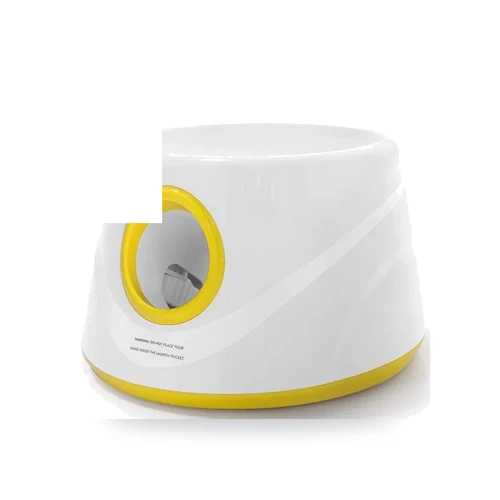
FetchMate Automatic Ball Launcher
Yellow launcher + 3 mini ETPU balls (58 mm) + USB charging cable, in one box.