· Loïc Chiappini
Ball Obsession in Dogs: When Fetch Stops Being a Game
We sell ball launchers. Writing this article is against our short-term interest and we are doing it anyway, because the owners most likely to buy a fetch machine are often the owners of exactly the dogs who need one handled carefully — high-drive, tireless, already a bit fixated. Getting this right is the difference between a machine that helps and a machine that makes things worse.
Drive versus compulsion
Most ball-mad dogs are simply ball-mad. They are thrilled, they are focused, and when the game ends they shake off and go to sleep. That is drive, and it is healthy — it is the same instinct that makes retrievers good at their job.
Compulsion looks different. VCA's clinical framing is useful precisely because it is unglamorous: a behaviour repeated often enough to disrupt the dog's daily routine. Not "likes the ball a lot". Disruption. The dog that will not drink, will not eat, will not lie down, cannot be called away, and starts the behaviour again the moment it is released.
of dogs seen by veterinary behaviourists are diagnosed with a compulsive disorder — it is a real diagnosis, not a figure of speech
— VCA Animal Hospitals, 2026
The signs worth taking seriously
| Healthy ball drive | Worth a closer look |
|---|---|
| Excited before, settled after | Cannot settle for hours after a session |
| Takes water when offered | Refuses water while a ball is in play |
| Can be called off with a decent recall | Recall collapses entirely near a ball |
| Enjoys other games and sniffing | No interest in anything that is not the ball |
| Stops when tired | Runs past the point of exhaustion or injury |
| Relaxed around the stored ball | Stares at the cupboard, whines, guards the ball |
The right-hand column is not a diagnosis — it is a reason to talk to your vet. The RSPCA's general advice on behaviour change applies here: if a dog shows regular signs of stress, ask your vet, who may refer you to an animal behaviourist. Compulsive disorder is what clinicians call a diagnosis of exclusion, which means pain and medical causes get ruled out first. A dog obsessively chasing a ball on a sore hip is a different problem from a dog with a compulsion.
Breeds where it is worth being early
Compulsive behaviours cluster in certain breeds — VCA lists Doberman pinschers, bull terriers, miniature schnauzers, German shepherds, Great Danes and the retrievers among those with recognised patterns. Add the working herding breeds that UK homes are full of, and you have a decent overlap with the dogs whose owners buy fetch machines in the first place.
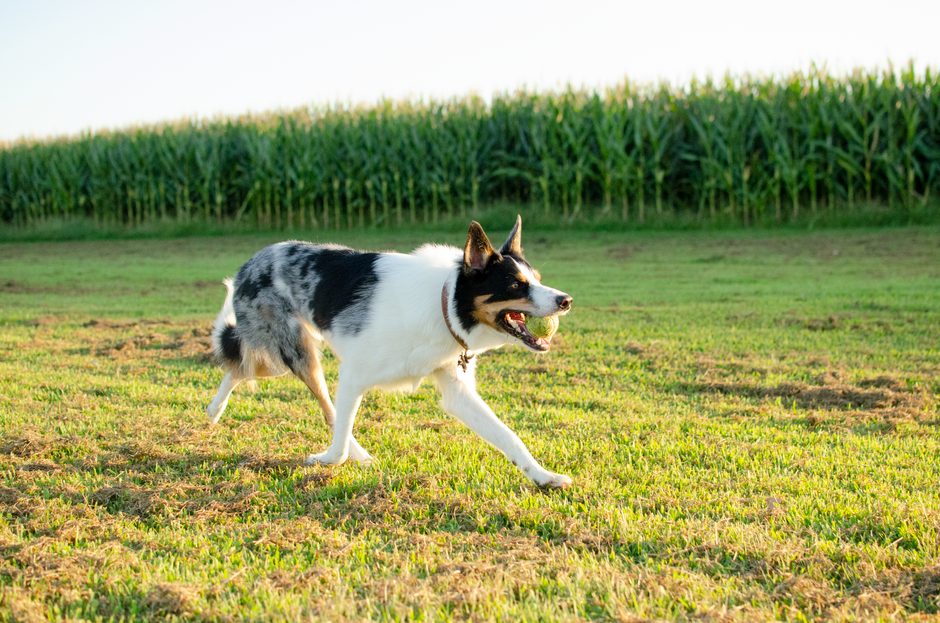
This does not mean a collie should not play fetch. It means a collie's fetch should have a beginning, a middle and an end that you decide.
What to change, in order
1. Put the ball away. Not as punishment — as management. A ball permanently available is a permanent trigger. It comes out for a session and goes back in a cupboard the dog cannot see. VCA is explicit that you should not scold a dog for repetitive behaviour; you change the environment instead.
2. Cap the session before the dog does. Ten focused minutes, then stop while the dog still wants more. Ending on the dog's terms teaches that the game runs until collapse; ending on yours teaches that it has an off switch. This is the single most useful habit with an automatic launcher, because a machine will never get tired and call it a day for you.
3. Build a settle into the end of every session. Two minutes of sniffing, a chew, a mat. The dog needs to practise coming down from arousal, and that is a skill like any other.
4. Swap some fetch for sniffing and problem-solving. A treat ball, scatter feeding, a snuffle mat — jobs that use the nose instead of the chase. Our guide to the types of dog ball covers which toy does which job, and a herding ball is worth knowing about for exactly these dogs: it satisfies the instinct without a small object to fixate on carrying.
5. Train a proper "leave" around the ball. Calling a dog off a ball mid-arousal, rewarding heavily and releasing it back to the game is difficult, and it is the recall that actually matters. Our training guide uses the same structure.
Does a launcher make obsession worse?
It can, and pretending otherwise would be dishonest. A machine removes the natural brake on fetch: your arm. It never tires, never gets bored, and will happily fire until the battery dies. For a dog already tipping toward compulsion, that is the wrong tool used the wrong way.
Used deliberately, though, a machine can help. The throw is identical every time, which lowers the frantic unpredictability some dogs find winding. It runs on the shortest setting indoors, which keeps arousal lower than a long sprint. And because you are not throwing, you are free to actually watch your dog — to notice the point where enjoyment turns into something driven, which is very hard to spot when you are focused on your own throw.
Two practical guardrails if you own one: use the timer in your own head rather than the machine's battery life, and never leave a dog unsupervised with a running launcher. The wider safety picture — mouth injuries, joint stress, the launch pocket — is in our safety guide.
The honest bottom line
If your dog plays fetch hard and then sleeps soundly, enjoy it — that is a dog doing what it was built for, and a launcher will make your life easier. If your dog cannot stop, cannot settle and has lost interest in everything else, no purchase fixes that. Talk to your vet, and be prepared to hear that the answer involves less ball rather than more.
We would rather lose a sale than sell a machine into that situation. If you are unsure which side of the line your dog is on, that is a conversation for a professional who can see your dog, not for a product page.
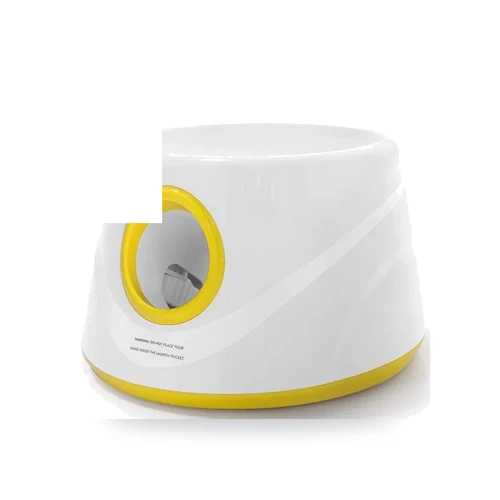
FetchMate Automatic Ball Launcher
Yellow launcher + 3 mini ETPU balls (58 mm) + USB charging cable, in one box.