Buying guide
Automatic Dog Ball Launcher: the four things that decide it
Every automatic launcher does the same thing — a sensor sees a ball, a spring throws it. What separates a machine your dog uses daily from one that ends up in a cupboard is narrower than the marketing suggests: ball size, throw distance, power source and noise. Everything else is detail.
1. Ball size — the one that sends machines back
This is the single most common mismatch, and it is not obvious from a product photo. A standard tennis ball is 65 to 68 mm across. FetchMate is built around 58 mm ETPU balls and ships with five of them. Put a tennis ball in it and the funnel jams — the manufacturer says so plainly in the manual, and we would rather you read it here than discover it in the garden.
That 58 mm figure also sets who the machine is for: dogs of roughly 5 to 25 kg. Above that weight, a 58 mm ball stops being a toy and starts being a choking hazard. If your dog is bigger, buy a launcher designed for standard tennis balls — we say the same thing on our small dog page, from the other direction.
2. Throw distance — and a warning about the numbers
| Setting | Distance | Where it works |
|---|---|---|
| Distance 1 (default on power-up) | 6 m | Hallway, long room, small garden |
| Distance 2 | 10 m | Average UK garden |
| Distance 3 | 14 m | Park, field, large garden |
Take distance claims in this category with real caution. Listings for machines of this class routinely quote 3, 6 and 9 metres — for this unit that is simply false, and it is one of several errors we found when we checked the listing against the manual. Ours are 6, 10 and 14 m, from section 4.2 of the manufacturer manual, and the machine starts on the shortest setting every time you switch it on.
3. Power — check what is in the box
FetchMate charges over USB-C. The box contains the launcher, five 58 mm balls, a USB-A to USB-C cable and the manual — and no mains adapter. You almost certainly own one. We mention it because unboxing is a bad moment to find out, and because this is exactly the sort of detail that quietly disappears from product listings.
4. Noise — the reason some dogs never take to it
The fix is patience rather than a different machine. Start with the launcher switched off and treats around it. Load it yourself and throw by hand for a session or two. Then run it on Distance 1 with your dog at a comfortable distance, and let them approach on their own terms. Buyers on the manufacturer's listing describe puppies being startled at first and settling within a few sessions — we cover that in teaching a dog to use a ball launcher.
The part nobody sells you: loading is the hard bit
The machine will throw indefinitely. Whether your dog ever uses it depends entirely on whether they learn to drop the ball back into the funnel — and that is a training job, not a hardware feature. Most dogs get there in a handful of short sessions; some never do, particularly dogs who like being chased more than they like fetching.
Which leads to the thing we would rather say before you buy than after: a machine that never tires removes the natural end of the game. Set sessions by the clock, not by your dog stopping, and put it away in between. We wrote about this properly in ball obsession in dogs.
What we can and cannot tell you
Every specification on this page comes from the manufacturer's manual. We do not hold a test unit, so nothing here is measured by us — not the noise level, not the battery life, not the throw accuracy. Where the listing and the manual disagreed, we followed the manual and listed the discrepancies on how we test. And we have no customer reviews yet, which we explain rather than fabricate on our reviews page.
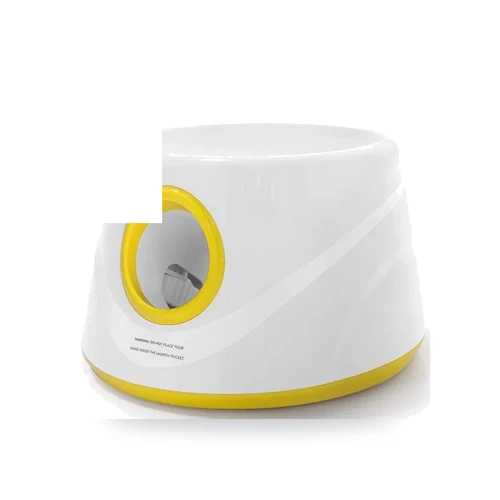
FetchMate Automatic Ball Launcher
Yellow launcher + 3 mini ETPU balls (58 mm) + USB charging cable, in one box.
Automatic dog ball launcher FAQs
How does an automatic dog ball launcher work?
Your dog drops a ball into the funnel, a sensor detects it, and a spring-loaded mechanism throws it. That is the whole loop — and the part people underestimate is the first half. The machine will throw all day; teaching a dog to load it is the actual project, and it takes most dogs a few short sessions.
How far does an automatic ball launcher throw?
FetchMate has three settings: 6, 10 and 14 metres, and it powers on at 6 m every time. Be careful reading distances elsewhere — some listings for this class of machine quote 3/6/9 m, which is simply wrong for this unit. Ours come from the manufacturer manual, section 4.2.
Can I use tennis balls in it?
No, and this is the most common mistake. FetchMate is built around 58 mm ETPU balls and ships with five of them. A standard tennis ball measures 65–68 mm: it jams the funnel. The manufacturer explicitly advises against tennis balls in this machine, whatever the product photos elsewhere might suggest.
Does it need mains power or batteries?
It charges over USB-C, and the box contains the launcher, five balls, a USB-A to USB-C cable and the manual — but no mains adapter. You almost certainly have one already; we mention it because finding out at unboxing is annoying, and because plenty of listings for this type of product stay quiet about it.
Is it quiet enough for indoor use?
It works indoors on the 6 m setting, and the manufacturer recommends outdoor use first. It is not silent: the launch spring makes a distinct sound on every throw. Sound-sensitive dogs need introducing gradually — machine switched off first, treats around it, then short sessions.
Will it suit any size of dog?
No. The 58 mm ball suits dogs from roughly 5 to 25 kg. Above that, a 58 mm ball becomes a choking risk and you want a launcher built for standard tennis balls instead. We would rather lose the sale than sell you a machine with a ball your dog can swallow.
Will an automatic launcher make my dog ball-obsessed?
It can, and this is worth taking seriously. A machine that never tires removes the natural end of the game. Cap sessions by the clock rather than by your dog stopping, and keep the launcher put away between sessions so it does not become a permanent fixture.