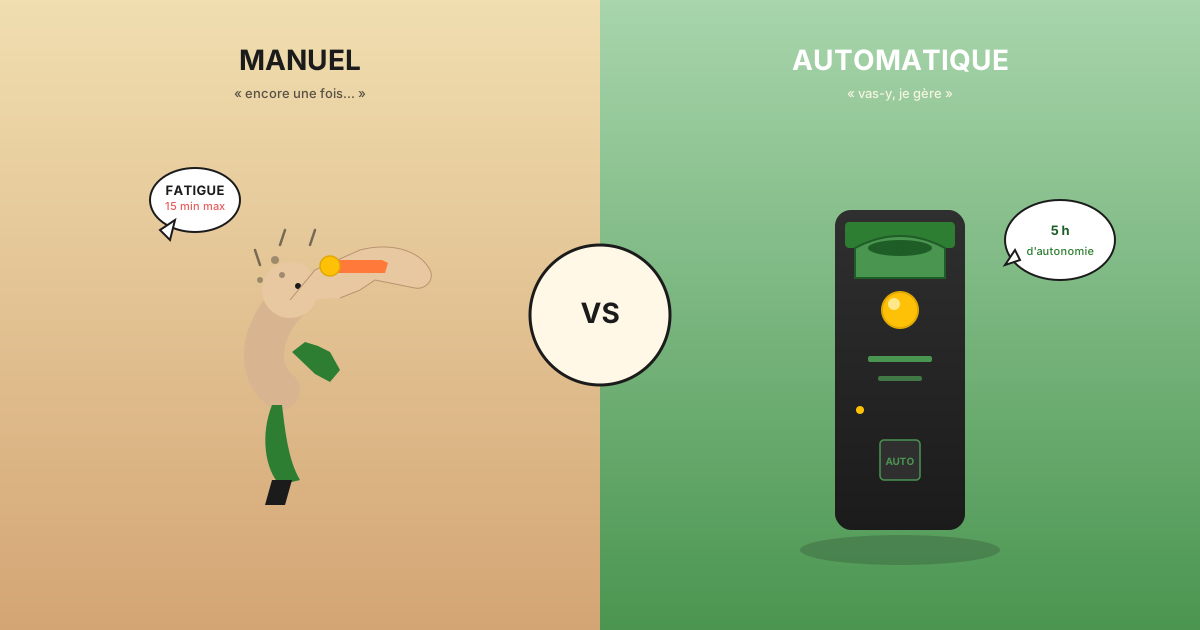
DIY dog ball launcher: is it worth building one yourself?
DIY dog ball launcher plans — pneumatic, spring-loaded, electric. Honest take on whether building your own is worth it vs buying a tested launcher.
I get this question every week from clients in Brighton: “Can I just build a ball launcher myself?” The internet is full of YouTube videos showing pneumatic, spring-loaded and electric homemade designs. Some look impressive. Most are dangerous, unreliable, or both. Here’s an honest take after testing five DIY designs and rejecting all of them.
The three main DIY approaches
1. Pneumatic (compressed air)
A PVC tube, a bike pump, an electric solenoid valve and a tennis ball. Press a button, the air fires the ball.
The good: cheap (~£30 in parts), throws hard. The bad:
- Air pressure is wildly inconsistent — sometimes 50 ft, sometimes 5
- A poorly tuned pneumatic launcher fires at stupid speeds and can break a ball, or worse, hurt your dog
- No safety sensor — it fires when you press the button, regardless of where your dog is
- Compressor noise scares most dogs
Verdict: don’t.
2. Spring-loaded (catapult style)
A wooden frame, two heavy springs, a release mechanism. Pull, load ball, release.
The good: no electronics, cheap (~£40 in parts). The bad:
- Hand strength required — defeats the purpose for anyone with a bad shoulder
- Spring snap-back is genuinely dangerous if you’re not careful
- Inconsistent distance, depends on spring tension
- Not autonomous — you still have to load and fire
Verdict: a Chuckit Pro at £15 does the same thing more reliably.
3. Electric motor + funnel (closest to commercial design)
This is the only DIY format that approximates a real automatic launcher: a hopper, a motor with a friction wheel, a release flap.
The good: in theory, it works. The bad:
- Parts cost £80–120 — by the time you’ve sourced motor, microcontroller, sensors, hopper, frame, you’re at the price of a finished launcher
- Time investment: 20–40 hours of design, 3D printing, assembly, debugging
- No safety sensor unless you specifically design one in (most DIYers don’t)
- Reliability: the motor wears within months; bearing failure is the #1 issue
- No warranty, no spare parts, no support — when it breaks, you start again
Verdict: only worth it if you genuinely enjoy the build process more than the end result. As a tool, you’re spending more time on the launcher than your dog will ever spend playing with it.
The hidden risks of DIY
I’ve seen the following in client homes over 8 years:
- Cracked PVC pneumatic tube that exploded on session #4, sending shrapnel at the dog (thankfully missed)
- Spring-loaded catapult that pinched a finger, requiring stitches
- DIY electric launcher with no safety sensor that fired a ball into a cocker spaniel’s eye — vet bill £180, still has a slight squint
- Homemade funnel with sharp edges that cut a dog’s tongue when they tried to retrieve a stuck ball
The shared issue: safety isn’t designed in from scratch. Commercial launchers have infrared sensors, rounded plastic edges, controlled spring tension and motor torque limiters because manufacturers test them on hundreds of dogs before shipping.
When DIY makes sense
Honestly, I can think of three scenarios:
- You’re an electronics or 3D-printing hobbyist and the build itself is the fun part
- Your dog has very specific needs (specific ball type, specific distance, specific noise level) that no commercial product covers
- You’re a school teacher or maker doing this as a project with kids — fine, just don’t use it on a real dog after, unless heavily tested
For 99% of UK dog owners, the time and money saved by buying a tested launcher outweighs the satisfaction of a DIY build.
Cost-benefit reality
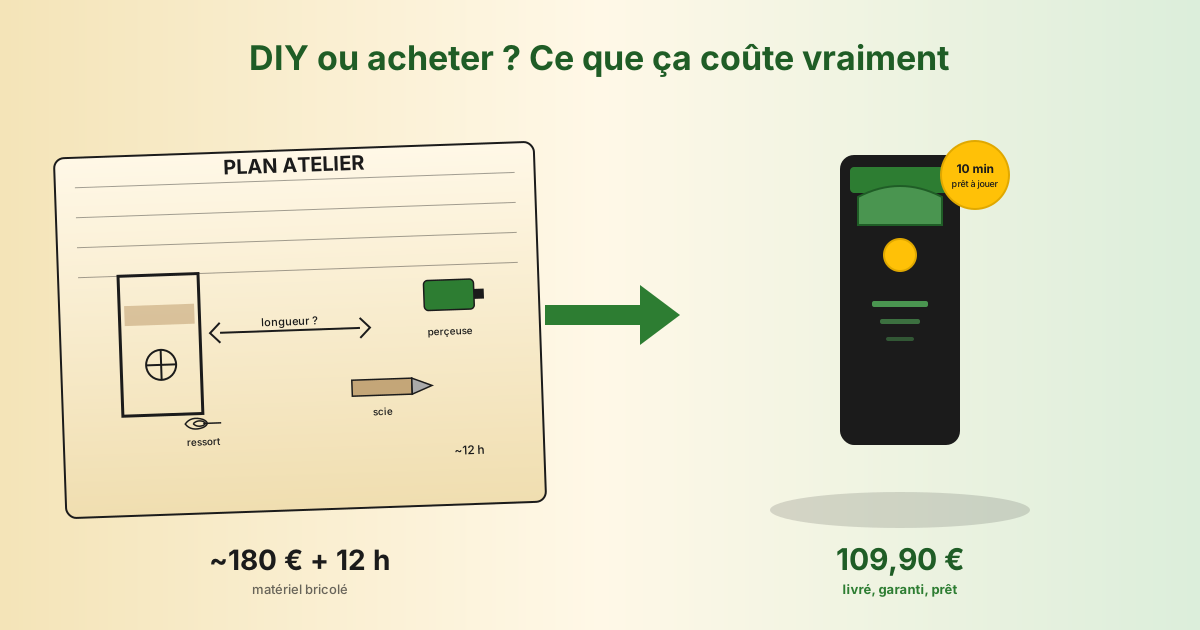
| DIY electric | Commercial (ours) | |
|---|---|---|
| Parts cost | £80–120 | £79.99 |
| Time to build | 20–40 hours | 0 hours |
| Safety sensor | Custom (often missing) | Built-in IR |
| Warranty | None | 2 years |
| Replacement balls | Random sizes | 2-inch standard refills £12/12-pack |
| Reliability | <12 months on average | 5+ years |
| Repair if broken | Start over | Email us, replacement in 48h |
What I tell my clients
If you’ve got the skills and the curiosity, DIY a launcher for the fun of it — but don’t trust your dog’s eye to it. Use it once or twice as a curiosity, then buy a tested unit for daily use.
If you don’t have a strong reason to build one yourself, buy a tested launcher. The PetSafe at £159 is the gold standard for big breeds. Our compact launcher at £79.99 is the right call for small and medium breeds. Both have safety sensors. Both have warranties. Both have replacements available when something fails.
Join our waitlist to be notified when our compact dog ball launcher goes on UK sale, with a launch-day discount.
Or if you’ve got specific DIY questions I haven’t covered, email contact@dog-ball-launcher.co.uk — I’ll happily answer (and probably try to talk you out of it).
Ready to give your dog a proper workout?
Our automatic dog ball launcher ticks the seven boxes that matter: 3 distances, USB-C charging, infrared safety sensor, 60 dB quiet, mini 2-inch balls, 2-year warranty, 30-day money back.
Join the UK waitlist — £79.99 at launch